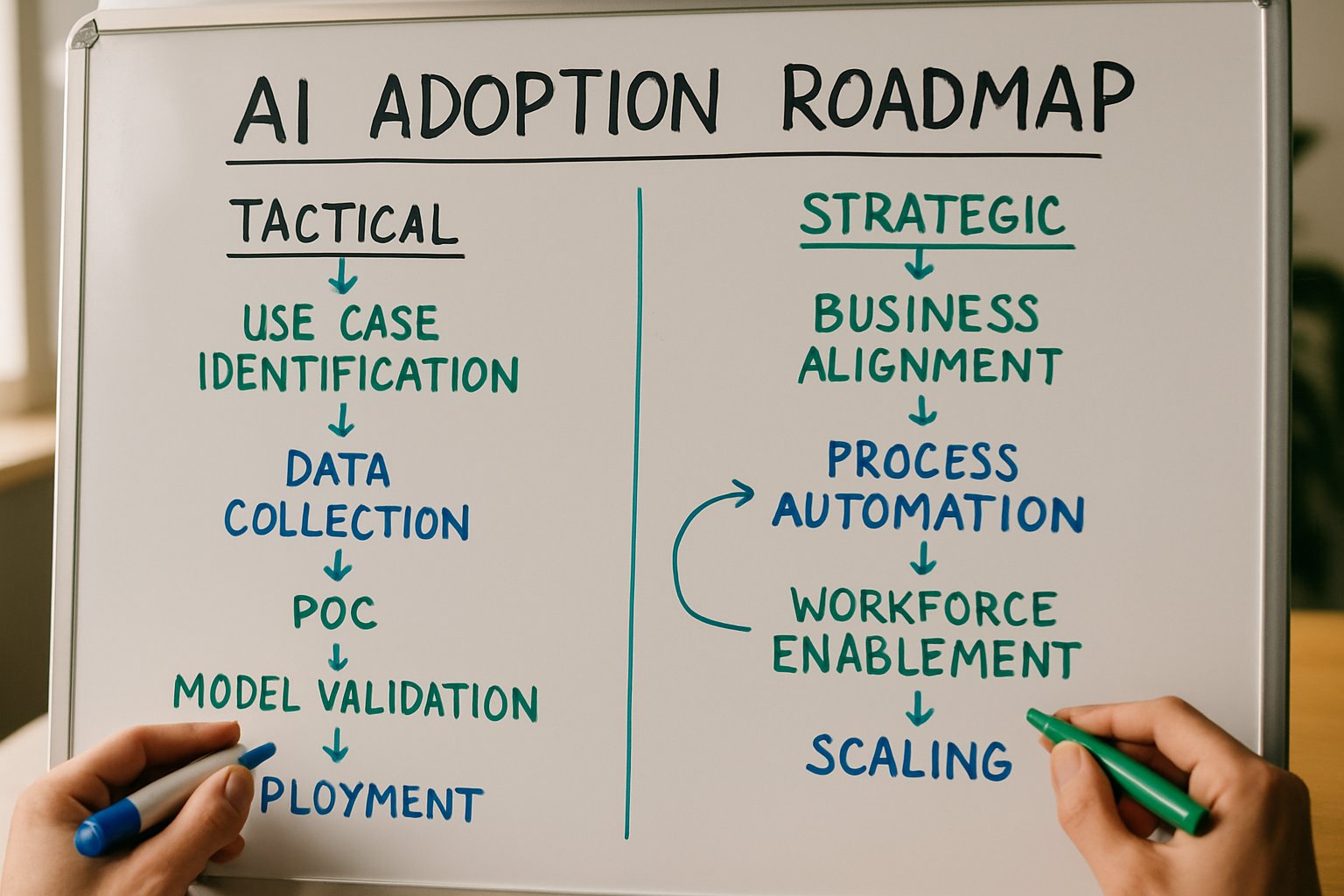
Tactical vs Strategic AI Adoption Roadmap
Boards now demand measurable returns from AI adoption. However, many programs still stall after flashy demos. Consequently, leaders ask a simple question: should we focus on tactical quick wins or build a strategic operating model from day one? This article compares both paths, presents new market data, and offers an AdaptOps-based playbook for sustainable enterprise value.
Current Market Reality Snapshot
Recent studies paint a sobering picture. McKinsey reports that only 39% of firms see EBIT impact from AI. Meanwhile, Gartner predicts 30% of generative projects will be abandoned by 2025. Furthermore, BCG finds that a small elite captures most gains, widening the value gap.
Despite soaring budgets, many teams linger in pilot purgatory. In contrast, integrated programs scale rapidly and yield 3.7× average ROI, according to IDC. These numbers confirm one insight: AI adoption succeeds only when experiments tie directly to business outcomes, funding gates, and governance controls.
Key takeaway: Market evidence rewards disciplined scale plans. Next, we contrast the two dominant approaches.
Tactical Approach Clearly Explained
A tactical method launches limited pilots fast. Teams test feasibility, gather feedback, and learn with minimal commitment. Moreover, executive sponsors like its speed and low cost.
However, research exposes recurring gaps. Tactical pilots often omit data readiness, security simulations, and change management. Consequently, they fail to cross funding gates, causing value erosion. Gartner’s abandonment forecast highlights this risk clearly.
Key takeaway: Tactical speed offers learning benefits yet rarely guarantees enterprise ROI. Let’s examine the strategic alternative.
Strategic Approach Clearly Explained
A strategic model embeds AI into a broader operating cadence. Leaders define business KPIs first, then run governed pilots, and finally productize winners. Additionally, they invest in talent, telemetry, and quarterly reviews.
High performers follow this pattern. McKinsey notes that successful firms reinvest over 20% of digital budgets into AI capabilities. BCG calls these organizations “future-built” because they treat AI as a living capability, not a project.
Key takeaway: Strategic programs demand more planning yet yield sustainable scale. Evidence follows.
AI Adoption Value Evidence
Multiple analysts validate the payoff. IDC’s Microsoft-sponsored study shows 3.7× average ROI for integrated initiatives. Top quartile performers report over 10× returns. Moreover, EY warns that governance lag amplifies risk, reinforcing the need for strategic rigor.
Adoptify.ai clients mirror these results. ECIF-funded pilots deliver ROI signals within 90 days, then expand using AdaptOps gates. As telemetry confirms value, finance teams approve wider rollouts without protracted debate.
Key takeaway: Quantified value favors disciplined models. Understanding failure modes strengthens this conclusion.
Key Failure Patterns Unpacked
Pattern 1: Unclear problem framing. Teams chase novelty instead of business pain. Consequently, benefits remain anecdotal.
Pattern 2: Data chaos. Poor data quality derails models and inflates costs. Gartner lists this as a top abandonment driver.
Pattern 3: Governance gaps. Without risk controls, CISOs halt expansion. EY notes that only half of leaders have responsible controls today.
Pattern 4: Talent shortfall. Projects struggle when users revert to legacy workflows. Upskilling and in-app guidance are critical.
Key takeaway: Each pattern maps to a missing AdaptOps element. Mitigation requires a structured framework.
AdaptOps Scale Framework Detailed
Adoptify.ai’s AdaptOps loop converts pilots into repeatable capabilities. The cycle follows four gated stages:
- Discover: Map use cases, baseline KPIs, and simulate risks.
- Pilot: Launch ECIF-funded quick starts with in-app guidance.
- Scale: Productize winners, add telemetry, and automate approvals.
- Embed: Certify roles, push micro-learning, and monitor drift continuously.
Furthermore, governance-as-code and Purview simulations shift security reviews left. Executive gates ensure funding only flows to proven use cases. Therefore, organizations avoid pilot purgatory and accelerate AI adoption confidently.
Key takeaway: AdaptOps offers a practical bridge between tactical energy and strategic discipline. Implementation guidance follows.
Critical Implementation Best Practices
The following checklist distills cross-industry lessons:
- Start with outcome metrics, not algorithms.
- Fund pilots with explicit scale pathways and time-boxed ROI checks.
- Embed governance from day one using policy simulations and drift alerts.
- Provide role-based enablement through in-app nudges and certifications.
- Productize winning use cases with playbooks and SLAs.
- Run quarterly governance reviews to reallocate investment.
Moreover, maintain concise scorecards that link business KPIs, security status, and user engagement. Consequently, leaders can decide investment moves within hours, not months.
Key takeaway: Following these steps converts experimentation into enterprise value. We now close with a strategic verdict.
Conclusion
Tactical pilots deliver fast insights yet often stall without governance. Strategic programs integrate funding gates, telemetry, talent, and product thinking. The evidence shows that organizations embracing a disciplined loop achieve superior returns and resilience.
Why Adoptify AI? The platform unifies AI adoption with interactive in-app guidance, intelligent user analytics, and automated workflow support. Enterprises onboard faster, raise productivity, and scale securely. Experience AdaptOps today by visiting Adoptify.ai.
Frequently Asked Questions
- What is the difference between tactical pilots and strategic AI adoption?
Tactical pilots provide rapid insights with low cost but often miss data readiness and governance. Strategic approaches integrate funding gates, continuous telemetry, and in-app guidance for sustainable, enterprise-wide AI adoption. - How does Adoptify AI accelerate AI adoption?
Adoptify AI unifies AI adoption with interactive in-app guidance, intelligent user analytics, and automated workflow support, enabling faster onboarding and secure, scalable implementations for measurable enterprise ROI. - What benefits does the AdaptOps loop framework offer?
The AdaptOps loop transforms pilots into repeatable AI capabilities. It guides teams from discovery to scaling, combining real-time telemetry and role-based in-app nudges to achieve continuous improvement and sustainable ROI. - How can organizations avoid pilot purgatory in AI projects?
Organizations can avoid pilot purgatory by setting clear business KPIs, enforcing data quality controls, and embedding governance from the start. Adoptify 365’s guided framework and automated support facilitate smooth scaling.

FEATURED
Artificial intelligence adoption: Copilot consulting ROI math
February 4, 2026
FEATURED
Microsoft Copilot Consulting: Bulletproof Security Configuration
February 4, 2026
FEATURED
Where Microsoft Copilot Consulting Safeguards Data
February 4, 2026
FEATURED
Microsoft Copilot Consulting: Automate Executive Presentations
February 4, 2026
FEATURED
Microsoft Copilot Consulting Slashes 15 Weekly Hours
February 4, 2026