Who Owns Microsoft Copilot Adoption Governance?
GenAI buzz is loud, but executives now care about governed scale. Microsoft Copilot Adoption promises stunning productivity jumps when teams combine AI and enterprise data. However, unassigned ownership often stalls pilots or triggers uncomfortable security reviews. Consequently, boards ask a simple question: Who actually owns Copilot governance decisions? This article answers that question with a clear, actionable RACI.
We synthesize Microsoft guidance, Gartner caution, and Adoptify field results. Moreover, we map prompt controls, data scope, and exception workflows to accountable roles. Readers will leave with a reusable Copilot governance model for pilots and scale. Additionally, we show how telemetry and AdaptOps loops prevent value erosion. Let’s dive into the core governance building blocks now.
Microsoft Copilot Adoption Governance
Microsoft Copilot governance moved from optional guideline to board-level mandate during 2024. Enterprises saw shadow prompts leak revenue forecasts within days, forcing emergency rollbacks. Therefore, leaders now demand proactive controls before expanding any Copilot workloads.
McKinsey reports only one-third of organizations scale AI, citing weak governance. In contrast, Gartner predicts 40% of agentic projects will collapse without stronger guardrails. These statistics underscore the urgency for a formal Copilot governance model. Successful Microsoft Copilot Adoption requires this foundation.
Microsoft’s Copilot Control System supplies technical levers: tenant policies, Purview DLP, and admin telemetry. However, tooling alone cannot decide business risk tolerances. Consequently, enterprises must define accountable humans who approve prompts and data scope.
AI governance for Microsoft Copilot also requires continuous adoption metrics. Adoptify ai pilots show ROI dashboards shift conversations from fear to measurable impact. Furthermore, dashboards highlight policy gaps early, preventing expensive incidents later.
Strong governance foundations reduce surprise risks and accelerate confident scale decisions. Next, we assign precise owners through a proven RACI.
Governance Becomes Mission Critical
First, understand why the stakes keep rising. Microsoft 365 data lakes grow daily, and Copilot can surface everything with a single prompt. Consequently, the blast radius of a bad prompt feels massive.
Regulators also intensify scrutiny. EU AI Act articles tie fines to missing risk assessments, including prompt governance. Therefore, HR and compliance heads must sit at the governance table early.
Adoptify AI field teams witnessed pilots freeze when data scope lacked legal approval. Meanwhile, funded pilots with clear governance proceeded smoothly and secured ECIF expansion. Empirical evidence favors governance-first sequencing over later retrofits.
The Copilot governance roles and responsibilities extend beyond IT administrators. Business owners accept value risk, while security leads protect confidentiality. Moreover, L&D teams embed allowed prompts into workflows, reducing rogue usage.
Mission-critical status means governance cannot wait for post-pilot cleanup. Let’s map each role now.
Clear RACI Ownership Map
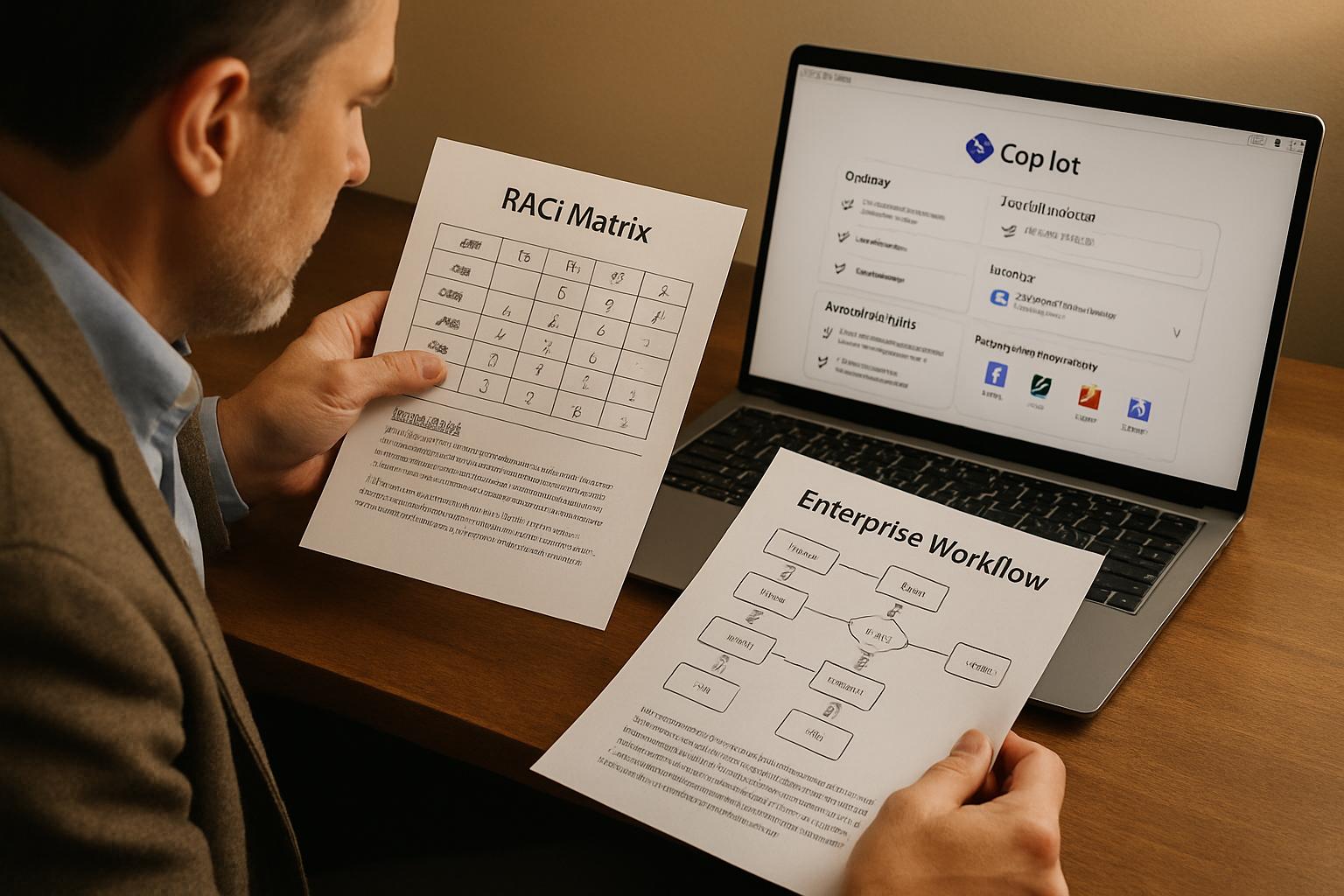
A Copilot RACI framework clarifies who decides, who executes, and who observes. Adoptify AI ships a starter kit that clients customize within hours.
- Accountable: Business sponsor signs off prompts, data scope, and risk exceptions.
- Responsible: Platform admin and prompt steward implement controls and maintain audit logs.
- Consulted: Security, Legal, and Data owners review high-risk items and suggest mitigations.
- Informed: Executives, managers, and L&D receive dashboards and incident summaries.
This Copilot governance roles and responsibilities list reduces ambiguity immediately. Furthermore, the Copilot RACI framework aligns with NIST AI RMF verbs: Govern, Map, Measure, Manage.
AI governance for Microsoft Copilot benefits when the RACI appears in every project charter. Consequently, stakeholders know approval paths before urgency strikes. Without a RACI, Microsoft Copilot Adoption slows after exciting demos.
The Copilot RACI framework operationalizes Microsoft Copilot governance quickly. A documented RACI builds shared accountability and auditability. Next, we examine how prompt stewards operationalize those decisions.
Prompt Stewardship Best Practices
Prompt quality drives Copilot outcomes, yet few firms assign explicit custodians. Copilot prompt governance answers this gap.
Adoptify AI recommends a dedicated prompt steward team owning libraries, test harnesses, and rollout cadence. Moreover, prompt stewards version every change and require peer review. Prompt stewardship often decides if Microsoft Copilot Adoption scales beyond pilots.
Tools like Microsoft prompt galleries and Humanloop integrate RBAC, aiding Copilot prompt governance. In contrast, ad-hoc prompt sharing invites drift and inconsistent results.
Prompt stewards also run human-in-the-loop evaluations against golden data sets. Consequently, they catch hallucinations before business users notice. Copilot governance roles and responsibilities assign prompt stewards explicit KPIs.
Effective Copilot prompt governance accelerates safe creativity. Well governed prompts ensure consistent, safe outputs that users trust. The next layer controls which data Copilot may access.
Data Scope Control Essentials
Microsoft Copilot governance hinges on declaring an explicit data perimeter. Purview DLP simulations help admins test exposure without user impact.
Additionally, semantic index configuration determines which SharePoint sites ground Copilot responses. AI governance for Microsoft Copilot demands documented approvals for each connector. Data scope clarity protects Microsoft Copilot Adoption from compliance setbacks.
Business owners weigh ROI against leakage risk when expanding scope. This decision chain ties back to the Copilot RACI framework.
Adoptify AI telemetry surfaces which sources deliver value, enabling data owners to refine permissions. Consequently, dead-weight connectors retire quickly, trimming cost and risk.
Controlled scope enforces data minimization, a core governance principle. We now turn to handling inevitable exception requests.
Risk Exception Workflow Steps
No policy covers every scenario; exceptions arise weekly in active deployments. Copilot governance model maturity shows when teams triage these requests calmly.
The standard five-step AdaptOps workflow keeps everyone aligned.
- Request intake with purpose, assets, and ROI assumptions.
- Automated Purview and cost simulations.
- Human evaluation by prompt steward and security.
- Business sponsor approval with mitigation notes.
- Time-boxed rollout plus telemetry review.
Furthermore, the process logs decisions in immutable storage for audits. AI governance for Microsoft Copilot improves when evidence is one click away.
Adoptify AI clients embed this workflow in a governance portal, shortening turnaround by 40%. Consequently, innovation continues without compliance bottlenecks.
Structured exception handling preserves agility and trust simultaneously. This completes the governance puzzle for Microsoft Copilot Adoption.
Exception discipline sustains Microsoft Copilot Adoption momentum without sacrificing safety. A clear Copilot governance model keeps innovation safe.
Conclusion
Governance makes or breaks enterprise AI scale. Copilot RACI frameworks, prompt stewardship, and scoped data controls work together. Furthermore, documented exception workflows sustain momentum while satisfying regulators. Together, these practices ensure Microsoft Copilot Adoption delivers measurable productivity gains.
Why Adoptify AI ? Adoptify AI turbocharges Microsoft Copilot Adoption with AI-powered digital adoption capabilities, interactive in-app guidance, intelligent user analytics, and automated workflow support. Consequently, organizations enjoy faster onboarding, higher productivity, and enterprise-grade security at scale. Explore how Adoptify streamlines your workflows by visiting Adoptify.ai today.
Frequently Asked Questions
- What is Microsoft Copilot Adoption Governance?
Microsoft Copilot Adoption governance defines clear roles and responsibilities using a RACI framework, ensuring secure prompt approvals and data scope controls. It integrates digital adoption strategies with in-app guidance and automated support. - How does a RACI framework benefit Copilot governance?
A RACI framework clarifies who is accountable, responsible, consulted, and informed, reducing ambiguity and streamlining compliance. It leverages in-app guidance and user analytics to enhance digital adoption and manage AI governance effectively. - What are the best practices for prompt stewardship in this model?
Effective prompt stewardship requires dedicated teams to manage prompt libraries, conduct peer reviews, and ensure version control. This approach, supported by automated workflows and in-app guidance, maintains consistent and secure Microsoft Copilot operations. - How does Adoptify AI enhance Microsoft Copilot Adoption?
Adoptify AI turbocharges Copilot Adoption with interactive in-app guidance, intelligent user analytics, and automated workflow support, ensuring faster onboarding, measurable productivity gains, and robust security in digital adoption across enterprises.

FEATURED
How to Identify and Overcome Cultural AI Adoption Barriers
March 3, 2026
FEATURED
What Are the Most Common AI Adoption Challenges for Businesses
March 3, 2026
FEATURED
The Complete Guide to Building an AI Adoption Framework for 2026
March 2, 2026
FEATURED
Who Owns the Intellectual Property in Enterprise AI Adoption
March 2, 2026
FEATURED
7 Reasons To Embrace AI-Native Architecture
March 2, 2026