Why Enterprise AI Tools Fail At Scale
Sky-high expectations surround enterprise AI tools, yet most pilots never reach enterprise scale. Executives feel pressure, budgets shrink, and stakeholders demand proof. However, the root problems hide in processes, not algorithms. This article dissects common failure patterns and shares proven fixes drawn from AdaptOps deployments.
Enterprise AI Tools Gap
Scale Failure Data
Recent MIT research shows 95% of pilots deliver zero P&L impact. Meanwhile, McKinsey notes only one-third of organizations scale AI beyond isolated pockets. Consequently, leaders now focus on operationalizing value, not experimenting endlessly.
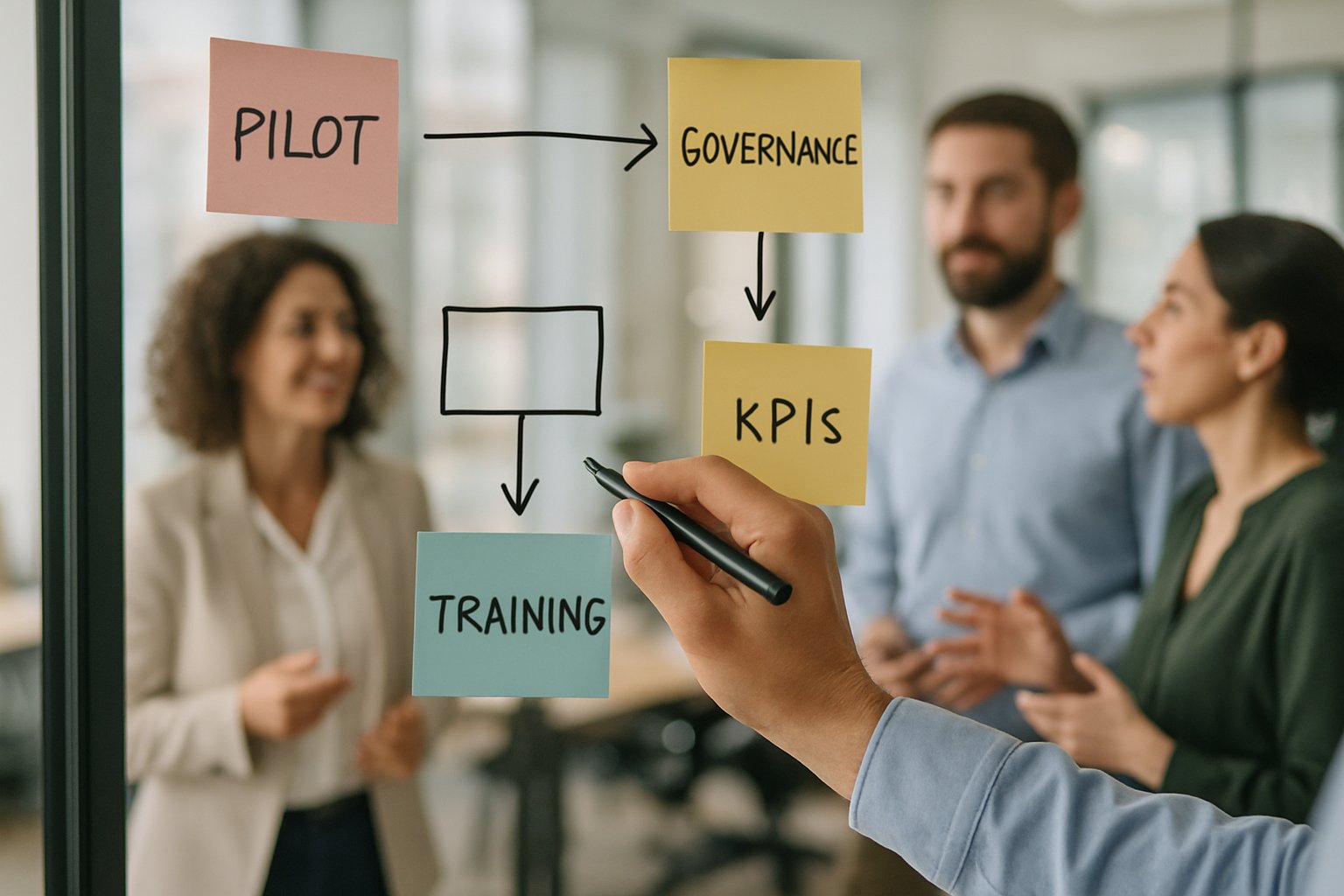
Adoptify AI telemetry matches those findings. Nearly 60% of firms lack a formal adoption plan, and 59% cannot measure productivity gains. Therefore, pilot enthusiasm evaporates when finance requests hard numbers.
Key takeaway: unmet governance, training, and measurement needs block progress. Next, we examine why these blockers persist.
Transitioning forward, we begin with the notorious pilot cliff.
Pilot-To-Production Cliff
KPI First Approach
Teams often jump into demos without a single business KPI. Consequently, pilots impress but never translate into budget line items. AdaptOps flips the script by setting a week-zero baseline and a week-four KPI checkpoint.
Furthermore, scorecards track minutes saved, Successful Session Rate (SSR), and cycle-time reduction. Finance receives near-real-time evidence; therefore funding conversations become easier.
Consider this simple cadence:
- Week 0: Capture baseline metrics.
- Week 2: Validate telemetry accuracy.
- Week 4: Present KPI delta and scale decision pack.
Key takeaway: business-first pilots avoid the cliff. The next barrier involves risk approvals.
Subsequently, we review growing governance pressure.
Governance Demands Accelerate
NIST RMF Alignment
Security chiefs scrutinize enterprise AI tools for leaks and bias. NIST’s AI RMF now guides many internal review boards. Consequently, approval queues lengthen, and pilots stall.
AdaptOps embeds policy-as-code templates, Microsoft Purview simulations, and automated audits. Moreover, weekly gates surface incidents early, satisfying risk teams without slowing velocity.
Key takeaway: governance-first design speeds scale. Yet success also depends on people.
In contrast, the next section tackles the human adoption gap.
Skills And Shadow AI
In-App Learning Wins
Employees often revert to consumer chatbots because enterprise rollouts feel clunky. This shadow usage undermines observability and inflates risk. Additionally, skill gaps widen when classroom training ends.
Adoptify AI’s role-based microlearning nudges new behavior inside workflows. Furthermore, champion networks and certification paths create social proof. Consequently, usage sticks, and telemetry reflects true productivity.
Key takeaway: continuous, in-context learning converts curiosity into habits. The next barrier concerns measurement itself.
Subsequently, we explore KPI blind spots.
KPI Measurement Gaps
Telemetry Driven Decisions
Many dashboards stop at prompt counts and ignore business outcomes. without clear impact, executives shelve enterprise AI tools. Therefore, measurement must bridge technical signals and financial metrics.
AdaptOps unifies SSR, latency, and drift data with minutes saved and cost per case. Moreover, monthly reviews align IT, HR, and finance in one narrative.
Key takeaway: transparent, business-linked telemetry secures ongoing investment. Yet hidden costs can still surprise leaders.
Consequently, we address cost friction next.
Hidden Cost Friction
License Optimization Path
GPU bills, duplicate seats, and over-provisioned licenses silently erode ROI. Deloitte reports compute concern rising sharply in 2025. Additionally, unused Copilot seats inflate budgets.
Adaptify AI audits licenses, reclaims dormant seats, and leverages ECIF funding to offset pilot costs. Furthermore, dashboards show cost per saved hour, giving procurement clear justification.
Key takeaway: proactive cost governance maintains momentum. Finally, we outline a repeatable success playbook.
Subsequently, we present the AdaptOps blueprint.
AdaptOps Success Blueprint
Continuous Improvement Loop
AdaptOps operates as a continuous readiness loop: Discover → Prove Value → Scale → Embed → Govern. Each phase includes defined gates, telemetry targets, and policy audits.
Moreover, monthly telemetry reviews, quarterly prompt refreshes, and semi-annual bias checks sustain performance. Consequently, the organization never drifts back into pilot purgatory.
Key takeaway: a structured cadence converts isolated wins into enterprise norms. We now close with practical next steps.
Conclusion: Most failures stem from misaligned KPIs, weak governance, skill gaps, poor measurement, and hidden costs. Addressing these areas with AdaptOps converts pilots into production realities.
Why Adoptify AI? The platform embeds AI-powered digital adoption, interactive in-app guidance, intelligent user analytics, and automated workflow support. Consequently, organizations enjoy faster onboarding, higher productivity, and secure, enterprise scalability. Discover how enterprise AI tools finally deliver value by visiting Adoptify AI today.
Frequently Asked Questions
- How does Adoptify AI help scale enterprise AI tools?
Adoptify AI transforms pilot projects into scalable enterprise AI deployments by leveraging digital adoption, KPI tracking, and intelligent user analytics to provide measurable business value and accelerate value realization. - What measures does Adoptify AI use to overcome the pilot-to-production cliff?
The platform sets week-zero baselines, employs week-four KPI checkpoints, and utilizes automated support and telemetry reviews, ensuring a smooth transition from pilots to full-scale production with clear business outcomes. - How does Adoptify AI address governance and compliance challenges?
Adoptify AI embeds policy-as-code templates, automated audits, and NIST RMF aligned controls, ensuring secure and compliant implementation of enterprise AI tools while satisfying rigorous risk and governance demands. - How does in-app guidance in Adoptify AI improve user adoption?
Interactive in-app guidance and role-based microlearning foster user engagement, streamline onboarding, and drive consistent behavior change, ensuring employees effectively adopt digital workflows and maximize productivity.

FEATURED
How to Identify and Overcome Cultural AI Adoption Barriers
March 3, 2026
FEATURED
What Are the Most Common AI Adoption Challenges for Businesses
March 3, 2026
FEATURED
The Complete Guide to Building an AI Adoption Framework for 2026
March 2, 2026
FEATURED
Who Owns the Intellectual Property in Enterprise AI Adoption
March 2, 2026
FEATURED
7 Reasons To Embrace AI-Native Architecture
March 2, 2026