Workforce Transition Analyzer: Closing AI Skills Gaps
Generative AI yanked digital change from incremental to exponential. However, humans learn linearly. The resulting shock demands deliberate workforce transition. Many organizations deployed Copilot inside 30 days, yet training budgets remained stuck in last year’s cycle. Consequently, frontline staff watch productivity stars surge ahead while their own confidence stalls. Surveys show 61% of workers scouting new skills but lacking structured paths. Meanwhile, analysts link over half of failed AI programs to talent shortages. Enterprises therefore need a diagnostic engine that exposes gaps early, simulates remedies, and funds targeted reskilling. Adoptify’s Transition Analyzer concept answers this call. The tool couples readiness data, skills graphs, and ROI dashboards to guide leaders from pilot facts to scale decisions. This article explores the gap drivers and the Analyzer architecture. It provides precise actions HR, IT, and L&D teams can start today.
Adoption Outpaces Workforce Skills
Global surveys confirm the pattern. AI adoption reached executive dashboards faster than any previous technology wave. However, readiness indicators trail badly. SHRM reported 45% of employees already using AI, yet most received under eight hours of formal training. Moreover, Adoptify pilot telemetry reveals 4,838 Copilot actions across a cohort, but competence concentrated in only 20% of users. This mismatch widens performance variance and morale gaps. Consequently, top performers reclaim hours while laggards fear redundancy. A disciplined workforce transition roadmap prevents that fracture. Enterprises must first baseline skills, then map each role’s adjacency to emerging tasks. Without that evidence, budget holders hesitate to fund reskilling, stalling scale. Therefore, a measurement-first mindset underpins every successful program.

Key takeaway: Adoption wins mean little if humans cannot keep pace. Next, we review the hidden economic penalties of delay.
Hidden Costs Of Lag
Training delays accrue silent costs. For example, lost productivity hides in extended cycle times and rework. IBM research estimates 20% productivity upside unlocked only after proficiency certification. Additionally, morale slides when unclear career paths persist. Consequently, voluntary attrition spikes, dragging replacement expenses higher. In contrast, quick support accelerates engagement scores and internal mobility. Financial analysts therefore urge leaders to quantify both direct and indirect impacts. Without a workforce skills gap analyzer, leaders fly blind. Adoptify’s sample ROI dashboards showcase time saved and payback within 90 days when skills uplift accompanies deployment. Yet, without transparent data, finance teams distrust optimistic adoption pitches. The workforce transition metric bridges this credibility gap.
Undocumented cost drains kill enthusiasm faster than technical glitches. The next section introduces a structured remedy: the Workforce Transition Analyzer.
Workforce Transition Analyzer Overview
The Analyzer operationalizes Adoptify’s AdaptOps artifacts into a single decision engine. It ingests HRIS data, in-app usage telemetry, and learning records. Moreover, it overlays an open skills ontology that aligns with Workday Skills Cloud or Gloat feeds. Each employee receives a transition score blending role displacement risk, skill adjacency, and time-to-proficiency. Consequently, HR, L&D, and finance teams share one objective truth set.
Core Diagnostic Modules Explained
- Readiness Scanner: Calculates baseline proficiency and compares it against task complexity.
- Gap Quantifier: Prioritizes missing competencies by impact on productivity and governance risk.
- Remediation Recommender: Simulates build, buy, or borrow strategies with cost and timeline projections.
- ROI Forecaster: Links proposed interventions to payback periods and executive scorecards.
Additionally, the Analyzer exports curated learning playlists and auto-enrolls users into role-based certifications. It also blocks advanced AI privileges until minimum proficiency thresholds are met, maintaining governance alignment. Enterprises can embed the engine inside their existing skills-intelligence platform rather than rip and replace.
The Analyzer turns abstract gap talk into numbers finance trusts. Next, we explore how to implement it without disruption.
Practical Adoption Implementation Roadmap
Successful rollouts follow a repeatable rhythm. First, instrument usage before training begins. Consequently, leaders capture an unbiased baseline. Second, select a 30-day pilot cohort that mirrors varied personas. Moreover, attach finance-grade KPIs such as minutes saved per case.
Third, feed pilot telemetry into the Analyzer. It then generates individualized workforce transition prescriptions within hours. Fourth, L&D teams push micro-learning through in-app guidance, reinforcing habits daily. Finally, executives green-light scale once ROI dashboards show sustainable lift.
Throughout the cycle, ai adoption metrics remain visible to every stakeholder. Therefore, momentum never fades. Meanwhile, the workforce skills gap analyzer keeps recalculating scores, ensuring interventions adjust as roles evolve.
Structured pilots shorten uncertainty while safeguarding culture. The following section links these steps to governance imperatives.
Governance Anchors Responsible Scale
Responsible scale demands parallel focus on policy and skill. Adoptify embeds policy templates aligned to NIST and ISO standards. Moreover, the Analyzer binds access controls to certification status. Consequently, untrained users cannot trigger sensitive copilots. Drift alerts flag unusual activity, prompting retraining rather than punishment.
Governance also covers data lineage, bias audits, and explainability. The Analyzer attaches evidence of compliant usage to each workforce transition milestone. Auditors therefore trace decisions without manual spreadsheets. Additionally, automated reports reassure regulators and investors alike.
Governance turns enablement into durable advantage. We now quantify the business payoffs leaders can expect.
Measuring Tangible ROI Gains
ROI answers fund every learning budget. Adoptify’s Copilot pilots documented 5.1 hours saved per user each month. Moreover, mature deployments report 60-75 minutes reclaimed daily. Consequently, operational costs drop by up to 20% within the first quarter.
The Analyzer captures three metric buckets. First, efficiency: time saved and error reduction. Second, revenue: faster quote generation and upsell conversion. Third, human capital: retention, promotion velocity, and engagement. Additionally, ai adoption velocity stays transparent through live dashboards. During each workforce transition cycle, the board sees cumulative gains.
Finance leaders appreciate scenario modeling. They can compare internal redeployment against external hiring. The workforce skills gap analyzer surfaces the cheapest path, often revealing internal talent hidden by outdated job titles.
Quantified evidence cements executive confidence. We now wrap with key lessons and the Adoptify AI advantage.
Conclusion
AI promises fade unless people advance alongside machines. However, leaders can close the gap with data, governance, and steady enablement. The Workforce Transition Analyzer delivers that precision by turning skills noise into actionable plans, feeding pilots, and validating ROI. With costs quantified and learning paths prescribed, organizations convert anxiety into opportunity.
Why Adoptify AI? The platform couples AI-powered digital adoption capabilities with interactive in-app guidance. It also offers intelligent user analytics and automated workflow support. Consequently, teams onboard faster and maintain higher productivity. Moreover, enterprise-grade scalability and security protect every innovation cycle. Begin your next workforce transition journey confidently by visiting Adoptify AI today.
Frequently Asked Questions
- How does Adoptify AI accelerate workforce digital transformation?
Adoptify AI leverages in-app guidance, automated support, and user analytics to identify and close skills gaps. This data-driven approach accelerates digital transformation and boosts overall employee productivity. - What key features does the Workforce Transition Analyzer provide?
The Analyzer includes readiness scanning, gap quantification, remediation recommendations, and ROI forecasting. These features help leaders identify skills shortages, optimize reskilling efforts, and drive efficient digital adoption. - How does in-app guidance improve employee onboarding?
In-app guidance offers step-by-step support during onboarding, reducing confusion and accelerating learning. This feature enhances engagement, ensures faster proficiency, and aligns with digital adoption best practices. - How is ROI measured through Adoptify AI’s digital adoption tools?
ROI is tracked using automated dashboards that monitor efficiency gains, revenue improvements, and employee engagement. Real-time analytics provide clear, measurable evidence of cost savings and productivity enhancements.
FEATURED
The Complete Guide to Building an AI Adoption Framework for 2026
March 2, 2026
FEATURED
Who Owns the Intellectual Property in Enterprise AI Adoption
March 2, 2026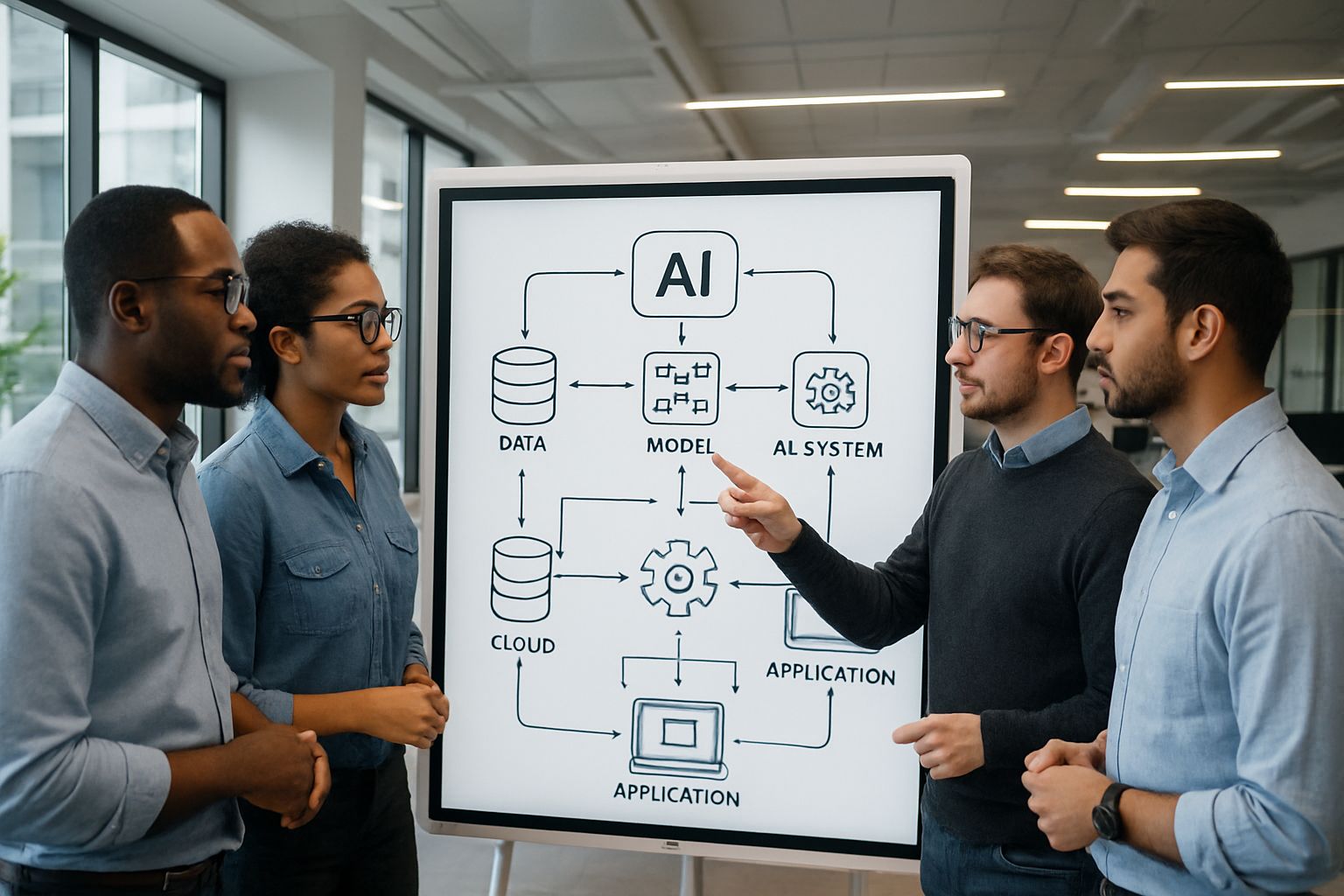
FEATURED
7 Reasons To Embrace AI-Native Architecture
March 2, 2026
FEATURED
Hybrid AI FAQ: Strategy, Governance, and ROI
March 2, 2026
FEATURED
Agentic AI Integration Playbook for Enterprises
March 2, 2026